
The meeting will address issues on design safety and regulations to facilitate progress in nuclear fusion facilities.
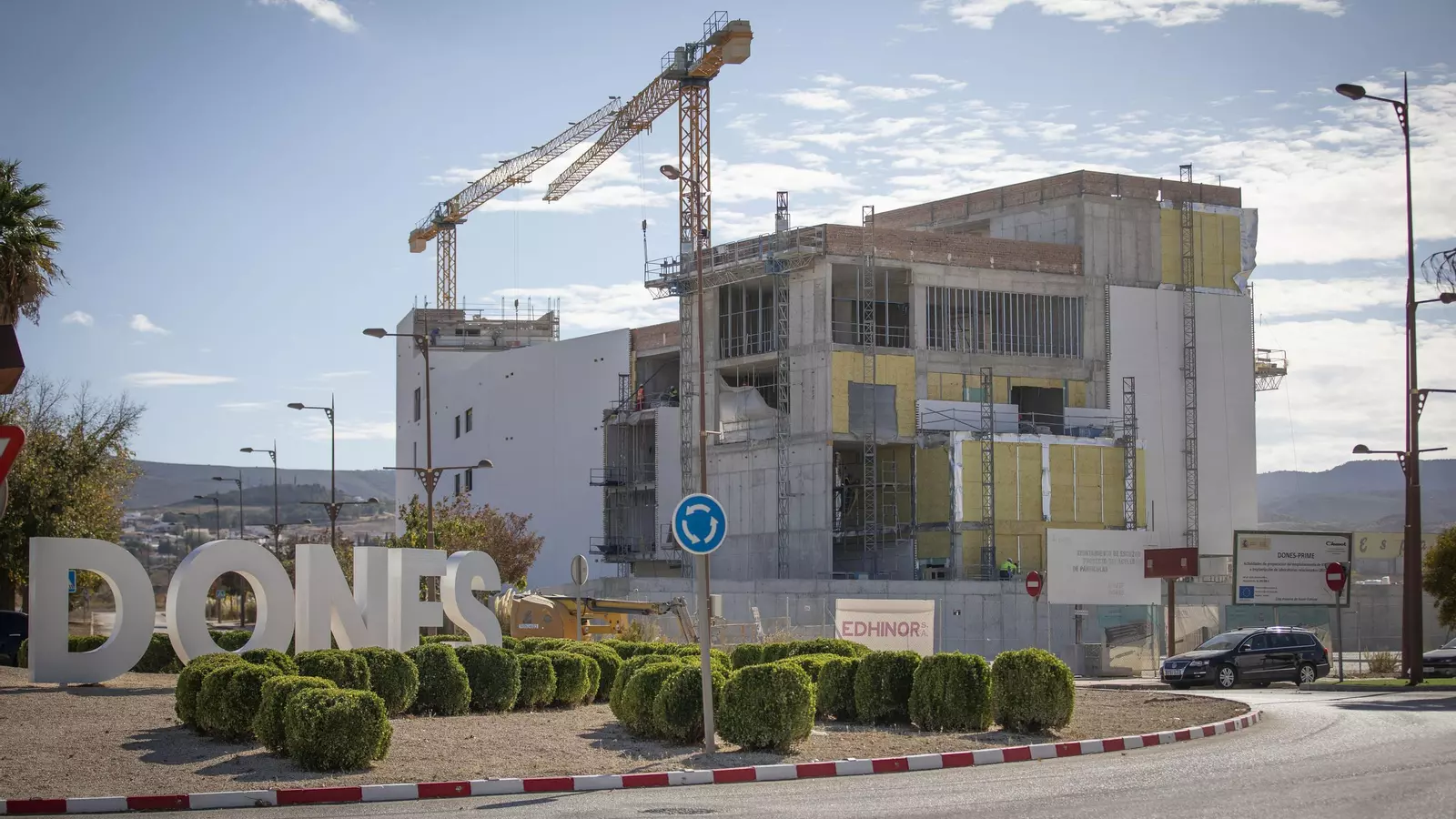
Work on one of the auxiliary buildings in Escúzar. / Antonio L. Juárez / PS
Granada will host a major international summit on nuclear fusion from June 2 to 6, 2025. The meeting will cover technical issues related to safety in design, safety assessment, and regulatory activities to facilitate further advances and the future development of nuclear fusion facilities, as specified in the letter exchange between the Spanish Government and the International Atomic Energy Agency (IAEA), based in Vienna. This exchange kicks off the organization of the event, providing details on the commitments made by the Spanish government, logistical arrangements, as well as administrative and security aspects.
This event, which will involve representatives from around 20 countries—including Russia, the United States, South Korea, Japan, Switzerland, and Ukraine—will also feature the European Commission, the ITER International Fusion Energy Organization, as well as EuroFusion and Fusion for Energy as non-governmental organizations.
The list of member countries includes Germany, Australia, Brazil, Canada, China, South Korea, Costa Rica, Denmark, Egypt, Spain, the US, France, India, Iran, Israel, Italy, Japan, Kazakhstan, Pakistan, Portugal, the United Kingdom, the Czech Republic, Sweden, Switzerland, Thailand, and Ukraine.
The purpose of the meeting, as detailed in the correspondence, is to introduce the technical documents from the International Atomic Energy Agency and the draft report titled "Safety and Regulation Considerations for Fusion Facilities." This report examines safety activities and the development of future nuclear fusion facilities, and it is expected to be a key part of the information exchange between the attendees about these types of infrastructures.
Around 50 people from the mentioned countries and organizations, along with IAEA representatives, are expected to participate in the event. The meeting organizers are requesting a conference room with a capacity for 60 people and an additional room for informational meetings for up to 10 people.
These spaces must be made available to the IAEA from May 31 to June 6, 2025, a pivotal year for the IFMIF Dones project, the scientific facility being planned in Escúzar, which is expected to be key for the development of materials that will later be used in nuclear fusion plants.
The letter exchange between Spain and the IAEA, published in the Official State Gazette (BOE) this Thursday, specifies practical aspects of the meeting, including the fact that the Agency will "promptly" inform the Spanish Government about the individuals who will "officially" attend the meeting and communicate the requirements they must meet, such as visa requests if necessary. It also states that the Spanish Government "will provide, at no cost to the IAEA, adequate and sufficient facilities and resources for the event for the entire duration," while also acting with "reasonable diligence" regarding security measures.
IFMIF DONES
Granada's hosting of this nuclear fusion meeting is closely linked to the IFMIF Dones project, which stands for International Fusion Materials Irradiation Facility – Demo Oriented Neutron Source. This is a unique neutron source worldwide, which, in addition to aiding the development of materials for future nuclear fusion plants, will benefit other scientific, technological, and industrial fields.
It is expected that the Granada accelerator will open doors for a new generation of high-power accelerators for multidisciplinary R&D, as stated by the Spanish Government in a written response in Congress a few months ago.
The facility is an international project with an estimated cost of about 700 million euros. Currently, Spain (which assumes 50% of the construction cost and 10% of the operational cost) and Croatia (5%) are participating, alongside Italy, which has signed a memorandum of understanding. The European Union is expected to formalize its participation in the coming months through Fusion for Energy, which is set to contribute 200 million euros once the "most important contributions" are confirmed, according to the organization. It is expected that Germany and Japan will join as the next partners in this major project.
Currently, workers from the Consortium are already operating in Escúzar, at the UGR Dones building of the University of Granada. It is anticipated that by 2025, they will move to the administrative building currently under construction, designed to accommodate about 250 workers. The construction of the facilities housing the accelerator and its main systems is expected to begin in 2026. The facility is projected to begin operations in 2028, with operations officially starting in 2033.
2025, the year the IFMIF Dones Building Foundation Contract will be Advanced
The Minister of University, Research, and Innovation, José Carlos Gómez Villamandos, chaired his first meeting of 2025 at the helm of the governing board of the consortium promoting the IFMIF Dones particle accelerator, following the rotating presidency of this body in 2024, which passed to the Ministry of Science, Innovation, and Universities.
During the working session, Gómez Villamandos reminded that this year will see the signing of the framework agreement for design and construction, which will kick-start, among other things, contracts for the preparation of the plot and the foundation of the building that will house the scientific infrastructure.
This framework agreement must still go through the Council of Ministers for approval and is allocated an estimated total budget of around 300 million euros, to be shared equally by both the Government and the Regional Government of Andalusia, as stated in an official press release. Each administration will contribute 211 million to the project until 2033, totaling 422 million euros.
Rodama is Rodríguez Arenas Matricería, the company founded 35 years ago by machinist Francisco Rodríguez Arenas, after the company he worked for closed. "Francisco came from working in France with a different mindset, here in Granada they would ask him for quick fixes, but he wanted to grow. He bought a machine and started investing…," recalls the administrator and wife of the now-retired founder, Mª Nieves Martínez de la Rosa. Today, the plans that Francisco used to sketch by hand are created by a large team of engineers who develop and create automation systems, machines, and production lines that do not exist on the market. Their main client is the French multinational in the automotive sector, Valeo. "For example, this is a machine we created to screw in a part of the headlight because a headlight is a whole world," explains Mari Nieves on-site.
The founder’s drive has been surpassed – proudly says Nieves – by his son Antonio Rodríguez, who grew up among the factory machines assembling parts as if playing with Legos. "The father created it, and the son is the one who transformed the company and took it to the next level; he always loved inventing," she states.