
The 3rd I+Dones Forum brings together representatives of the science industry at Cámara Granada to explore the development and employment opportunities generated by the project
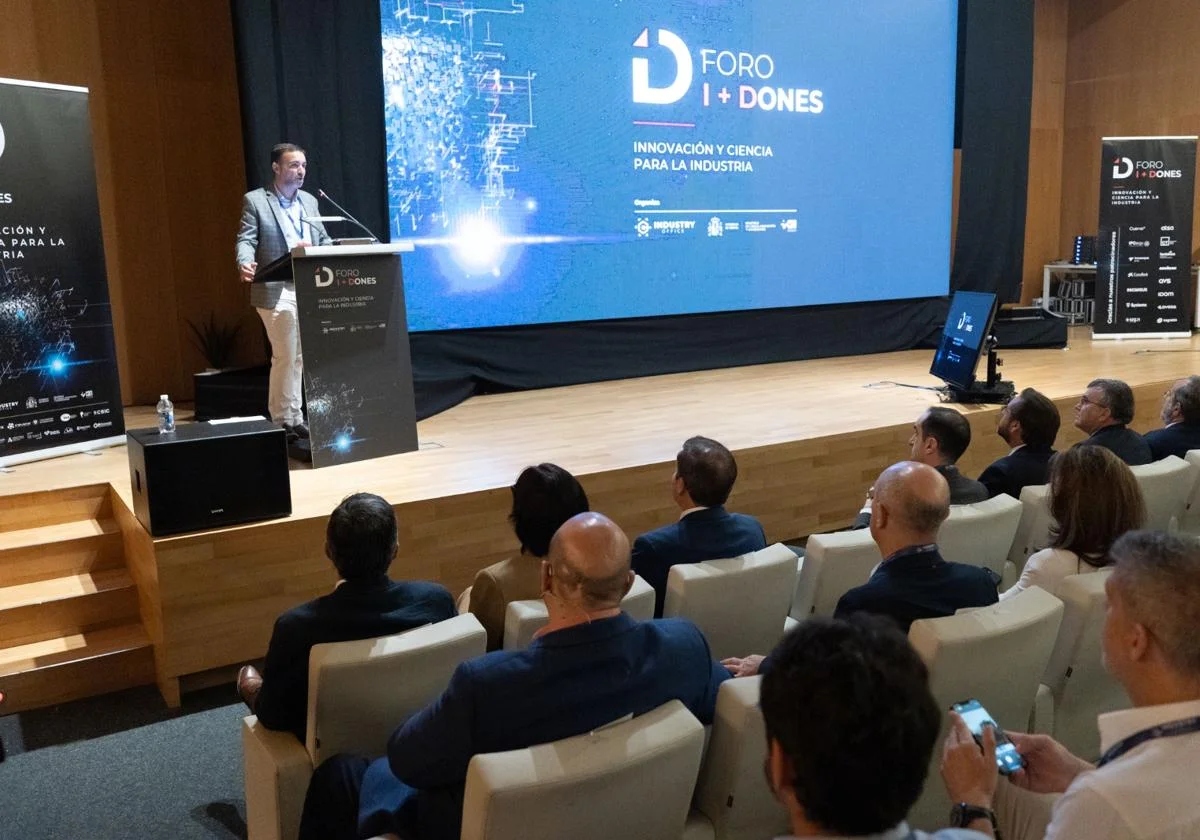
Roberto Álvarez addresses attendees at the 3rd I+Dones Forum. Photo by Pepe Marín
The third edition of the I+Dones Forum is taking place this week in Granada, gathering 250 companies interested in the business opportunities arising from the construction of the IFMIF-DONES particle accelerator in Escúzar. This facility is designed to validate the materials that will be used in future fusion power plants—a clean, cheap, and virtually inexhaustible source of energy.
The forum is organized by Industry Office—driven by Cámara Granada and the Spanish Science Industry Association (Ineustar)—in collaboration with the Centre for the Development of Industrial Technology (CDTI), Spain’s innovation funding agency under the Ministry of Science, Innovation, and Universities.
The event began on Thursday with a visit to the IFMIF-DONES facilities located in the Industrial, Technological and Innovation Area (CITAI) in Escúzar, followed by information sessions at the Carmen de los Mártires. Among the highlights were presentations from Fusion for Energy—the EU agency for fusion energy—and the German company Proxima Fusion, which is working toward launching the first commercial fusion power plant by the 2030s.
Main Building Tender Sparks Interest in the Construction Sector
On Friday, the plenary session was held at Cámara Granada, with 250 registered companies. Roberto Álvarez, Head of Innovation and Digital Transformation at Cámara Granada, emphasized that the forum is now a "consolidated national meeting of the science industry." In 2023, the first edition hosted 150 companies; in 2024, 200; and this year, the number has risen to 250. Álvarez highlighted the notable growth in Andalusian firms, which have doubled their presence and now represent 20% of participants.
“We’ve achieved all of our goals: maximizing the impact of IFMIF-DONES, the largest scientific facility in Spain; bringing the industry closer; and getting companies to believe in the project,” said Álvarez.
He added that the accelerator acts as a driver for technological development among local companies. For example, while only one company from Granada attended the ITER Business Forum in Marseille in previous years, this year fourteen companies participated. Moreover, nearly all contracts awarded for the development of the accelerator with CDTI funding—amounting to €60 million—include companies from Granada and Andalusia.
Creating Technology and Training National Industry
Ángel Ibarra, Director of the IFMIF-DONES Spain Consortium, emphasized that beyond the expected scientific results, one of the project's main goals is to “generate technology in Spain and enhance the capabilities of Spanish industry.”
Regarding the involvement of Granada-based businesses, Ibarra noted that seven local companies are already participating in and investing in R&D projects funded by the CDTI. Several others have been awarded service and supply contracts worth several hundred thousand euros, although it is still early to quantify the full impact since the core construction tenders are yet to be issued.
“We would like that if a company from outside wins a contract, they set up an office, workshop, or factory here,” Ibarra stated.
He clarified that under Spain’s public procurement law, a company’s location cannot be used as a selection criterion. “What matters is that Granada-based companies bid. If they win, great. But ideally, even if a company from Seville or Madrid is awarded a contract, it will eventually establish operations here. That is one of our aims.”
Growing Interest from the Construction Sector
In addition to the rise in total participants—especially local ones—Ibarra pointed out the presence of a new business profile: construction and building companies. These are joining the forum alongside firms from scientific, technological, consulting, and engineering sectors, driven by the upcoming tender of the project’s largest contract: the main building that will house the scientific facility. This massive structure (100 x 80 x 40 meters) will include all necessary auxiliary systems. Its total cost is estimated at around €300 million, and its construction will take several years.
A Strategic Project for High-Value Industry
Juan Antonio Tébar, Director of Innovation Policies at CDTI, explained that as the innovation funding agency under the Ministry of Science, “our goal through these unique and strategic projects is to enable our industry to become a supplier to large scientific and technological infrastructures, generating high-value-added jobs.”
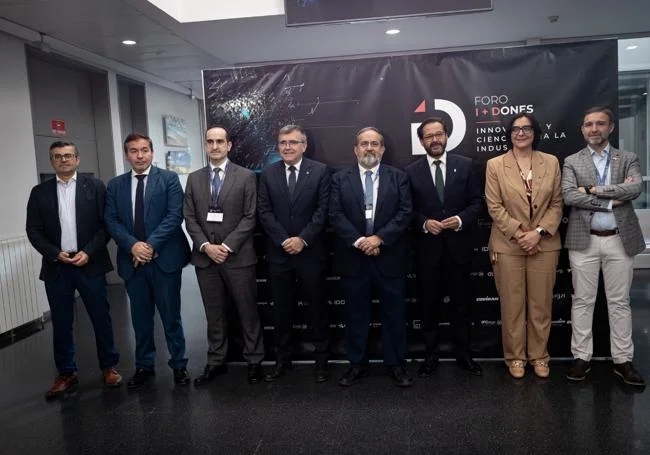
Hosts and authorities at the forum presentation. Photo by Pepe Marín
"It allows our industry to be involved in a key element for the development of nuclear fusion such as IFMIF-DONES, but also to serve as a technology provider for other major European facilities, such as ITER (the demonstration reactor built in France to generate fusion plasma), CERN (the Swiss particle accelerator), or large astronomical observatories."
Tébar emphasized that IFMIF-DONES is a successful example of public-private collaboration, highlighting the three prototypes built under the CDTI’s “Science Missions” call, which are already in Escúzar. These prototypes are intended to test different processes that will be applied in the future neutron source and have represented an investment of several tens of millions of euros. "It is extremely valuable for equipping our industry to handle large-scale projects with such high technical demands," he concluded.