
An office is preparing the local industry to access part of the 400 million in contracts already underway for Ifmif-Dones.
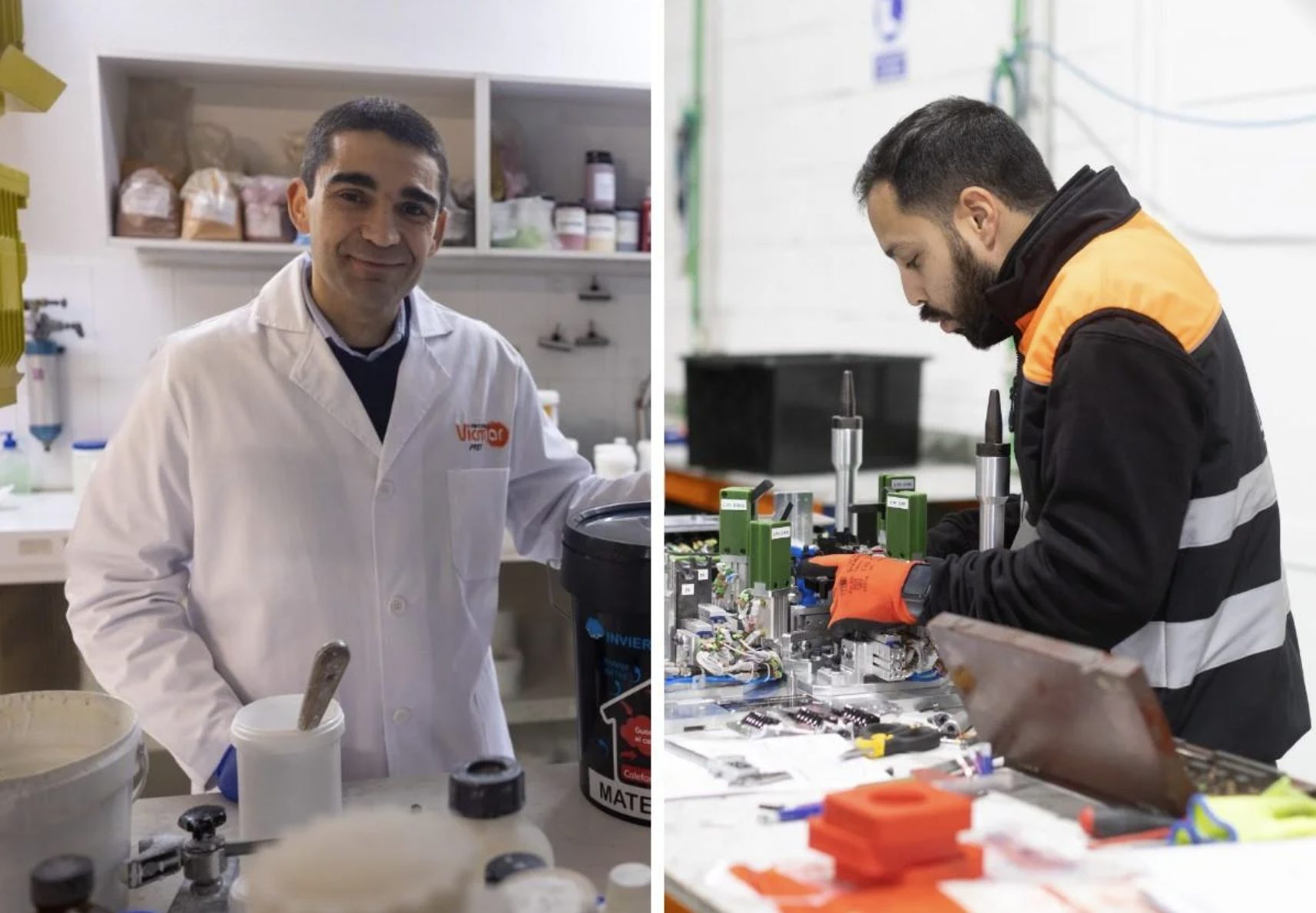
Two of the companies aspiring to work on the Granada accelerator. Pepe Marín
The great science industry had always seemed very distant from the industrial areas of Juncaril or Asegra. But that was before. Something very big, with the potential to transform the economy, is happening now in Granada. The construction of Spain’s largest scientific laboratory, the particle accelerator for the international Ifmif-Dones project in the Citai of Escúzar, is opening up a world of business opportunities for Granada’s SMEs, opportunities they hadn’t even considered before, and a privileged entry point to the great science industry, which moves over 40 billion euros annually worldwide.
The construction of the mega-laboratory that will study the materials necessary for future fusion energy reactors—physically, the works will start in 2026—will require all kinds of services and components, many of them high-tech and nonexistent in the market, but also others that are already produced by Granada-based companies, which need to be prepared to not miss this opportunity.
For the Ifmif-Dones Consortium itself, it was important to have a nearby industry to help them in the coming years, both for construction and for the future operation and maintenance of the facility. That’s why they teamed up with the local business community to find these companies, prepare them, and create a true industrial ecosystem in Granada linked to the great science sector.
The tool they are using to achieve this is the Industry Office, driven by Ifmif-Dones Spain, the University of Granada, the Institute of Astrophysics of Andalusia-CSIC, Cámara Granada, and the Spanish Association of the Science Industry, INEUSTAR. The initiative, formalized this January after two years of prior work, is already training and preparing Granada’s companies to be part of consortia that will compete for contracts to be launched by Ifmif-Dones. The Industry Office, which is physically located at the Cámara Granada headquarters, has already taken significant steps: the first being to locate potential Granada suppliers of services or components for the accelerator, many of whom had never considered working for a scientific infrastructure.
Excitement
“We have already perfectly mapped about fifty Granada-based companies from very different profiles, from large industrial or tech sector companies to spin-offs and SMEs that could provide services for the accelerator and are going to apply,” explains Roberto Álvarez, Innovation Manager at Cámara Granada, excitedly. Along with the Industry Office team, he has visited many of them, one by one. They are proud because, although most of them don’t currently focus on science, they are being very proactive and seeing the great opportunity that these multimillion-dollar contracts represent.
“We need to bring companies closer to the science industry because it’s not just Ifmif; they will be prepared to work in a high-value sector.”
— Roberto Álvarez, Innovation Manager at Cámara Granada
“Granada companies were not on the radar of the science industry, and we need to bring them closer because it’s not just Ifmif, which is the gateway; they will be prepared to work in a high-value-added sector. Spain is already the second country winning the most contracts for the ITER project (the experimental fusion reactor being built in France), which has a budget of 30 billion euros, and Granada’s companies need to be there,” he insists.
The office informs them about how this field works, the specific services the accelerator will need, and supports and encourages them to attend international industry forums. And it’s not just a bet for the future, but for the present. According to the Industry Office, Ifmif-Dones is currently moving contracts worth 400 million euros, including those that have already been tendered and those that will be launched in the next quarter. “Granada companies are showing great courage. We threw them the gauntlet, and they are picking it up,” concludes Álvarez.
The company working for the ‘German NASA’ and never manufacturing the same thing twice
Rodama is one of the Granada-based industries applying to work for the accelerator: “If we’ve come this far, it’s because we’re not afraid to create what doesn’t exist.”
Surprise is the recurring feeling for those who enter the Rodama facility in the 12th of October industrial park in Santa Fe: “How is this here?”. They don’t expect that behind the doors of a modest plant, full of nooks and crannies, lies one of the most cutting-edge industries capable of creating, piece by piece, any machine from scratch or producing technology for the German NASA. It is rare to see five-axis machines like the ones Rodama owns, a technology worth millions of euros and capable of manufacturing parts with millimetric precision.
Rodama, or Rodríguez Arenas Matricería, was founded 35 years ago by Francisco Rodríguez Arenas when the company he worked for shut down. “Francisco came from working in France with a different mindset. Here in Granada, they would ask him to do quick fixes, but he wanted to grow. He bought a machine, kept investing…” The story is recounted by the administrator and wife of the now-retired founder, Mª Nieves Martínez de la Rosa. Now, the blueprints Francisco used to make by eye are created by a large team of engineers, who develop and create automations, machines, and production lines that do not exist in the market. Their main client is the French multinational automotive company Valeo. “For example, here is a machine we created to screw a part of the headlight, because a headlight is a world,” explains Mari Nieves on-site.
The founder’s drive has been surpassed—proudly says Nieves—by his son, Antonio Rodríguez, who grew up between the machines of the factory, assembling parts like playing with Lego. “The father created, and the son is the one who transformed the company and took it to the next level. He has always loved inventing,” she says.
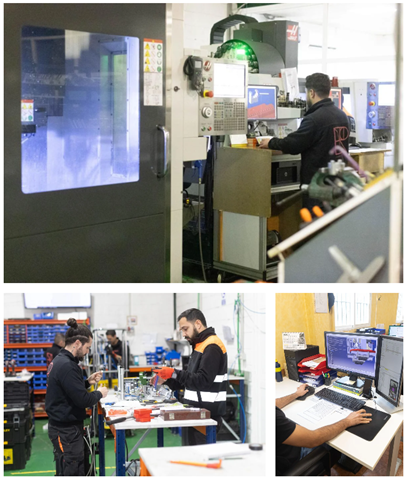
Several profesionals working in RODAMA. Pepe Marín.
In this company, with over three million in annual revenue and a team of 42 professionals—half of them engineers—they never get bored because they never manufacture the same thing twice. A profile that the Industry Office has identified as an ideal company to work for the accelerator. Additionally, Rodama already has experience with the science world. They are part of a European consortium, which includes the German Institute of Astrophysics and the University of Évora, to manufacture a tracking system for solar panels alongside eight companies from six countries. They have also manufactured some of the lenses used in radio telescopes for the Institute of Astrophysics.
The next stop is the accelerator. “Because it has such a high level of radioactivity, there can be no human handling inside the accelerator. Everything must be done with robotics, and current robots cannot withstand the radioactivity, so we will have to design those automatic systems that haven’t been invented yet… That’s our specialty,” smiles Antonio Rodríguez.
“We’ve never worked for accelerators, but we’re eager to. We have to be there! If we’ve grown, it’s because when we were asked for something we didn’t have, we created a department to invent it. We’ve come this far because we’re not afraid,” he concludes.
The Granada-based company that measures time in accelerators and the Chicago Stock Exchange
Located across from the Faculty of Computer Science and Telecommunications, Safran is a world leader in ‘white rabbit’ technology, which measures to the sub-nanosecond.
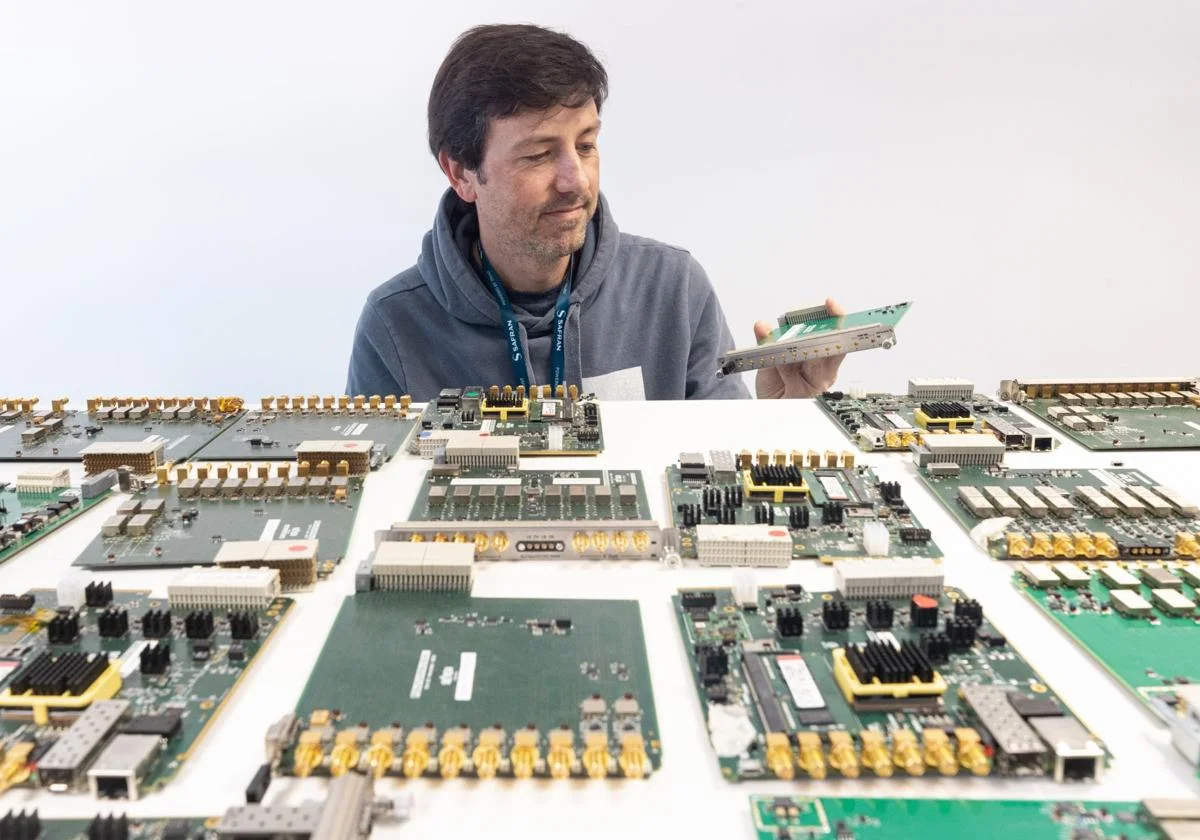
Several profesionals working in RODAMA. Pepe Marín.
The Ifmif-Dones project has opened a completely new world for Granada companies, but one in particular finds the accelerator universe part of its everyday business. In fact, it has been working for accelerator facilities worldwide, such as Ifmif-Dones in Japan, Alba in Barcelona, UKRI in the UK, CEA in France, ESS in Sweden, and CERN in Switzerland. The company in Granada with the most expertise in accelerators is Safran, formerly Seven Solutions, which changed its name two years ago when it was acquired by this French multinational in the aerospace sector.
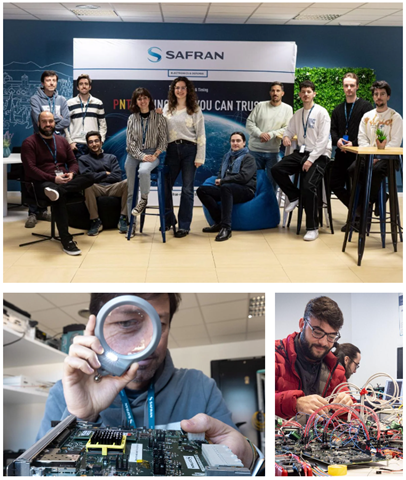
Part of the Safran team in Granada. Pepe Marín
The company was founded in 2007 as a spin-off of the University of Granada and grew so much that it was acquired by this giant with 92,000 employees in 27 countries. “We started with small projects close to science, but we were lucky to have a great team that knew how to knock on important doors and find applications for the technology beyond the scientific world. It’s been very good for us,” explains Pilar Gil, Science Manager at Safran in Granada.
They are leaders in using ‘white rabbit’ technology, named after the famous white rabbit from Alice in Wonderland who was always running late. It’s a new communication and synchronization technology with extremely precise time accuracy. “If your watch sends seconds, we go below the nanosecond,” says Gil. This technology came from the science industry, from the world’s largest accelerator, CERN, and is closely linked to this field, as it is used to control experiments involving particles.
But besides accelerators, Safran has clients in many other fields where measuring time is critical, such as finance. “We provide this technology for the Madrid Stock Exchange, the Chicago Stock Exchange, and the Frankfurt Stock Exchange… In the stock market, it’s crucial to measure the exact moment of a transaction, as it can determine the gain or loss of large sums of money. We add time markers to all the data to discern which transaction is the winner,” she explains.
Located across from the Faculty of Computer Science and Telecommunications, from which it draws talent and supports, Safran is closely tied to Granada. That’s why the possibility of working for Ifmif-Dones is especially motivating for them, and they have actively participated in the city’s bid for the project from the very beginning.
“We’re excited about the Ifmif-Dones project. It would be motivating and interesting to work less than 20 kilometers away. We feel very much part of Granada, and 90% of the employees at the office are from here. We’re more than ready to compete for service contracts and open to collaborating with Granada’s industries because the contracts coming out of Dones are huge, and we’ll need to form consortia,” she concludes.