
Observations from the James Webb Space Telescope have enabled the study of the center of the Milky Way in unprecedented detail
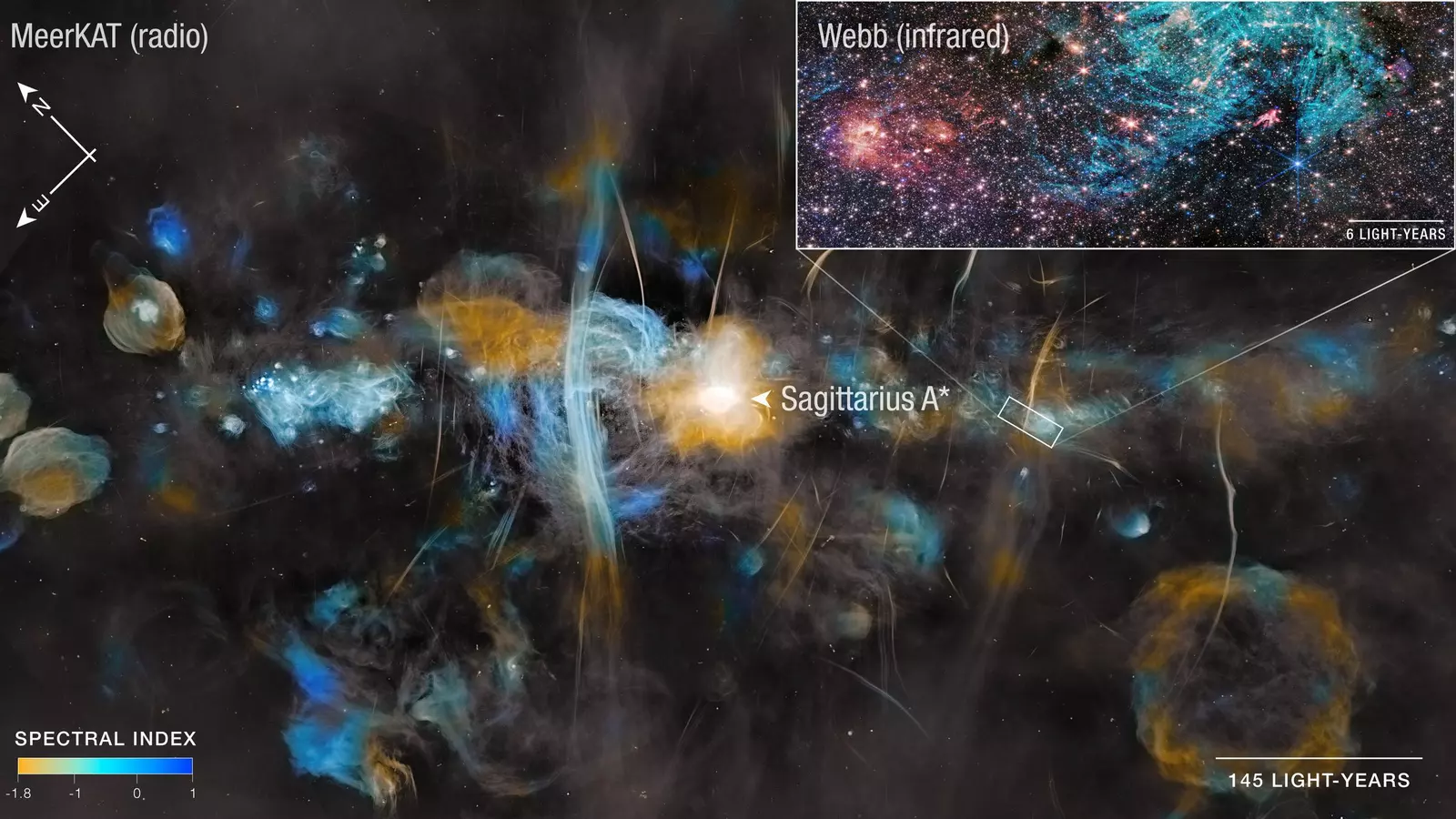
Images from MeerKAT and the James Webb Space Telescope of the star-forming region Sagittarius C.
The Institute of Astrophysics of Andalusia (IAA) has co-led two studies that, thanks to observations from the James Webb Space Telescope, have enabled the investigation of star formation in one of the most extreme regions of our galaxy, Sagittarius C, with an unprecedented level of detail.
The center of the Milky Way, our galaxy, is an extreme environment where intense cosmic phenomena transform space and matter. In one of its central regions lies a massive, dense cloud of interstellar gas and dust. Over millions of years, this cloud has collapsed under its own gravity, leading to the formation of thousands of new stars. This region is known as Sagittarius C.
The main objective of these observations was to study the processes of stellar formation, particularly in massive stars—those with more than eight times the mass of the Sun. Rubén Fedriani, the lead supervisor of the project, explains: “In their early stages of formation, stars typically exhibit jets of matter. In this study, we have detected more than a hundred jets associated with low-mass protostars, similar to our Sun. In addition, we have observed for the first time in the infrared the jets associated with two massive stars, each about 20 times the mass of the Sun.”
Thanks to this jet activity, the study has also discovered a new star-forming region. This finding suggests that star formation in this area follows similar processes to those in the rest of the galaxy, demonstrating that even in environments as extreme as the center of the Milky Way, new stars can be born.
The discoveries could also help solve a longstanding mystery about the innermost regions of the Milky Way, known as the Central Molecular Zone (CMZ), which includes Sagittarius C and other star-forming regions. This zone is characterized by large amounts of dense molecular gas, making it one of the regions with the greatest potential for star formation in our galaxy. However, despite its high gas density, the rate of new star formation in the CMZ is lower than models predict, prompting numerous studies to better understand the physical processes that regulate this activity.
The studies—co-led by the University of Colorado Boulder, the University of Virginia, and the Institute of Astrophysics of Andalusia—have found evidence of magnetic field lines crossing Sagittarius C, forming long, bright filaments of hot hydrogen gas that resemble spaghetti noodles. This phenomenon could be responsible for slowing down star formation in the surrounding gas.