
During an institutional visit to the research center, Rector Mercado announced that by the end of the year, the mechatronics equipment currently housed in the Faculty of Sciences will be installed there.
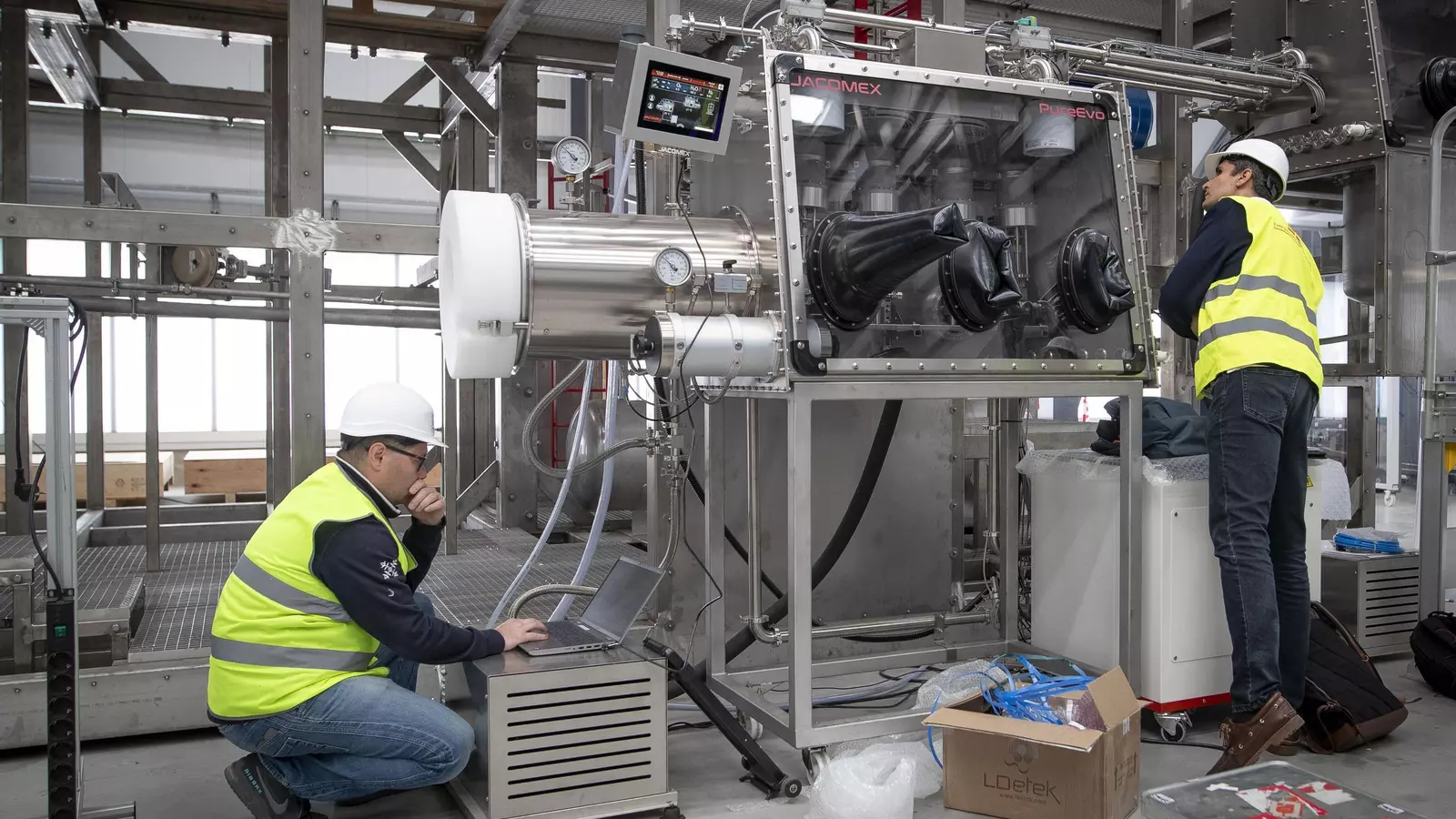
UGR Dones facilities in Escúzar.
“What we have here is one percent of what the accelerator will be,” says Ángel Ibarra, director of the IFMIF Dones Spain Consortium, pointing to the large tube wrapped in aluminum foil behind him. The particle accelerator in Escúzar, a major scientific project aimed at advancing the development of a new clean and inexhaustible energy source—nuclear fusion—already has its first work team at the UGR Dones building, located in the Escúzar Metropolitan Industrial and Technological Park.
The facility, operational for several months with a staff of about 40 people, was initially key in strengthening Escúzar’s candidacy as the host site for IFMIF Dones. It now houses part of the accelerator’s initial project team and features early prototypes, including the Multipurpose Vacuum Accident Scenarios (MuVacAS), Start-Up Monitoring Module (STUMM PROTO), Lithium Technologies Ciemat (LITEC), and the Quick Disconnection System (QSD). Before the end of 2025, the University of Granada’s Mechatronics group will be relocated to UGR Dones.
Rector Pedro Mercado announced this move, emphasizing that the Mechatronics lab’s work will help “build the research ecosystem” expected to form around the particle accelerator. In the large Escúzar building—where the symbolic groundbreaking will take place on May 19 with Science Minister Diana Morant—materials will be studied for eventual use in commercial nuclear fusion reactors. The research on new materials will be vital not only for future energy generation but also for fields like healthcare and aerospace.
“This is a project of national and global dimensions, to which we are fully committed from Granada, the University, the Andalusian Government, and the Spanish Government,” said Mercado. A one-million-euro grant from the Scientific Infrastructure call will finance the Mechatronics lab’s relocation.
“It’s important to attract people, but even more crucial to install unique equipment here,” Ibarra argued. “These one-of-a-kind facilities are what will make university researchers want to come and experiment here,” he added. “The key is to have experimental equipment found nowhere else in Spain—or even at universities—so that people are drawn to come here.”
The arrival of personnel and new equipment “will allow us to manufacture some components that cannot be made anywhere else,” Ibarra continued. “That requires other types of labs, and we’re working on that,” he added. “In fact, what you see here doesn’t exist anywhere else. It’s unique,” Ibarra explained.
Investment
So, what’s in UGR Dones? First, there’s a significant investment. The regional government allocated around 14 million euros for the land purchase, project development, and construction of the scientific building, in addition to launching the scientific equipment provided by the University of Granada. Meanwhile, the Center for Energy, Environmental and Technological Research (Ciemat)—under the Ministry of Science—granted another 14 million euros to the UGR to continue the project.
That investment is now embodied in the building and the equipment it houses. MuVacAS is an experimental prototype that will test the reliability of critical accelerator component designs. It spans 30 meters and can be described as the accelerator’s “tail.” It will allow researchers to analyze the behavior of various mechanical systems, components, and materials in the accelerator line under different incident scenarios.
The STUMM PROTO is essential for monitoring neutron and gamma ray fields during the startup phase of the IFMIF Dones facilities. It will feature 240 detectors to provide radiation field data. The QSD is part of the lithium systems group and will test the feasibility of remote-controlled connections essential to the accelerator’s operation.
LITEC is a lab designed to validate the lithium purification systems for the IFMIF Dones project—an indispensable component for the accelerator’s functionality.
Heading to Japan
All this equipment addresses critical needs for launching the Escúzar accelerator, an international project in which Spain and Croatia are partners, and Italy is a collaborating nation. A new partner country is expected to join in the coming days.
Ibarra announced he would travel to Japan next week, specifically to the Osaka World Expo. The event precedes the signing of a Memorandum of Collaboration (MoC) scheduled for Monday, May 19.
The Andalusian Minister for University, Research, and Innovation, José Carlos Gómez Villamandos, visited the center and highlighted UGR Dones’ “essential” role in the accelerator. The regional government is contributing 211 million euros to the project. Another 211 million comes from the Spanish Government, represented at the visit by Granada subdelegate José Antonio Montilla. Montilla emphasized that IFMIF Dones is already “a reality,” with researchers working in labs such as UGR Dones.
“One moment, please”
A notable moment occurred during the officials’ press briefing in Escúzar. After Rector Mercado and Ángel Ibarra had spoken, Minister Gómez Villamandos began his remarks, causing some discomfort among subdelegate Montilla’s team. The minister had to request, “One moment, please,” during his speech.
When it was Montilla’s turn, he pointed out that the consortium’s presidency lies with the Ministry. However, the presidency is rotating, and Gómez Villamandos currently holds the position. This was confirmed by the Ministry of Universities during the same press event.
So far, both the regional and national governments have worked jointly and harmoniously on the IFMIF Dones project since Granada became a candidate to host the facility. Both governments have contributed equally to the initiative—around 422 million euros.
The total projected cost for the accelerator is approximately 700 million euros, with an additional 50 million per year in operating costs. Currently, Spain and Croatia are official participants in IFMIF Dones. Italy collaborates, and the European Commission has earmarked nearly 200 million euros for the accelerator through Fusion for Energy. A new partner country is expected to be confirmed soon.